- Ph.D., Geology, The University of Wyoming, 1992. Dissertation: Tectonic evolution of the northern East Humboldt Range, Elko County, Nevada
- M.S., Geology, Stanford University, 1987. Thesis: Deformational history of the Southern Snake Range, Nevada, and the origin of the Southern Snake Range decollement, White Pine County, Nevada
- B.A., Geology, Earlham College, 1983, College Honors, Departmental Honors, Phi Beta Kappa
Allen J McGrew
Associate Professor
Full-Time Faculty
College of Arts and Sciences:
Earth and Environmental Geosciences
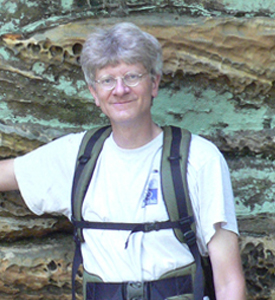
Allen J McGrew
Associate Professor
Full-Time Faculty
College of Arts and Sciences:
Earth and Environmental Geosciences
Degrees
Profile
Dr. McGrew began his teaching career at the University of Dayton in 1995 and teaches courses in introductory geology and earth science, engineering geology, structural geology and igneous and metamorphic petrology. He specializes in tectonics, the study of mountain-building processes, and his interests have taken him to a wide variety of settings around the world from the western U.S. Cordillera to South America, Europe, Asia and Australia. He has a passion for field research in mountainous terrains and has frequently engaged undergraduate students in research on and off-campus. He is also interested in service-learning, and together with his wife and fellow teacher, Heidi McGrew, he has innovated a program called Field Trip to Planet Earth that provides introductory earth science students with opportunities to develop hands-on educational activities for elementary school children in the Dayton area. He is also committed to interdisciplinary education and is currently partnering with faculty from Sociology and Civil Engineering to develop opportunities for interdisciplinary study both on-campus and abroad.
Faculty perspective
"My passion for teaching and research stems from seeds that were planted by my teachers and mentors during my own education. I seek to repay this debt by challenging and engaging my students to explore this dynamic and ever-surprising planet just as my mentors challenged me. This Earth has a history that is at once deep, intricate and profoundly important, impinging both on our understanding of ourselves and our ability to survive. Since my first view of mountains thrusting improbably upward to grasp the sky, I have been intrigued by how they form and what they indicate about this dynamic planet. What forces operate inside this Earth to lift some rocks into the air while sinking others to the floor of the sea? Why are such motions concentrated in certain areas, and what factors control how they evolve through time? Moreover, how do the large-scale physical structures and tectonic behavior of our planet dictate the distribution of resources and hazards that affect our ability to survive? These are a few of the questions that motivate my interests in teaching and research."
Professional activities and appointments
- Associate Professor, University of Dayton, August 2001-Present
- Coordinator of the Common Academic Program in the Sciences, January 2011-December 2012
- Chair, Department of Geology, University of Dayton, August 2007-June 30, 2011
- Assistant Professor, University of Dayton, Aug. 16, 1995-May 2001
- Post-doctoral Research Fellow, U.S. National Science Foundation, Structural Geology, 1992-94:
1992-93, hosted by Dr. Martin Casey of the Swiss Federal Institute of Technology (ETH), Zurich, Switzerland; 1993-94, hosted by Dr. Geoffrey Lloyd, University of Leeds, Leeds, England - Visiting Assistant Professor, Earlham College. (July 1, 1990-June 30, 1992)
- Visiting Assistant Professor, Earlham College. (Jan. 1, 1988-June 30, 1988)
Research interests
- Structural Geology
- Regional Tectonics
- Petrology
- Engineering Geology
Selected publications
Casey, M. and McGrew, A. J. (1999). One dimensional kinematic model of preferred orientation development, Tectonophysics (303), 131-140.
Kleinschrodt, R., and McGrew, A. J. (2000). Garnet plasticity in the lower continental crust: Implications for deformation mechanisms based on microstructures and SEM electron channeling pattern analysis. Journal of Structural Geology, 22, 795-809.
McGrew, A.J. (1993), The origin and evolution of the southern Snake Range decollement, east-central Nevada, Tectonics, 12, 21-34.
McGrew, A. J. (1997). Grand Tour of the Ruby-East Humboldt metamorphic core complex, northeastern Nevada: Part 2--Petrogenesis and thermal evolution of deep continental crust: the record from the East Humboldt Range, Nevada. In Link, K. P., Kowallis, B. J. (Ed.), Geological Society of America Field Trip Book Guide, 1997 Annual Meeting, Salt Lake City, Utah: Part One--Proterozoic to Recent Stratigraphy, Tectonics, and Volcanology, Utah, Nevada, Southern Idaho, and Central Mexico (pp. 270-275). Brigham Young University Geology Studies.
McGrew, A. J. (1998). In Snoke, A. W., Tullis, J. A., Todd, V. R. (Ed.), Quartzite fabric transition in a Cordilleran metamorphic core complex (pp. 484-489). The Atlas of Mylonitic and Fault-related Rocks.
McGrew, A.J., and Snoke, A.W. (in review) Geologic Map of the Welcome Quadrangle and an adjacent part of the Wells Quadrangle, Elko County, Nevada (1:24,000), Nevada Bureau of Mines and Geology.
McGrew, A. J., Peters, M. T, and Wright, J.E. (2000). Thermobarometric constraints on the tectonothermal evolution of the northern East Humboldt Randge metamorphic core complex, Nevada. Geological Society of America Bulletin, 45-60.
McGrew, Allen J.; Snee, Lawrence W. in Malavieille, Jacques, editor (1994) .40Ar/39Ar thermochronologic constraints on the tectonothermal evolution of the northern East Humboldt Range metamorphic core complex, Nevada Tectonophysics. v. 238 no. 1-4 p. 425-450
McGrew, A. J., Snoke, A. W. (2010). SHRIMP-RG U-PB isotopic systematics of zircon from the Angel Lake orthogneiss, East Humboldt Range, Nevada: Is this really Archean crust?: Discussion. Geosphere, 6, 962-965. Full Text (www) >>
Henry, C. D., McGrew, A. J., Colgan, J. P., Snoke, A. W., Brueseke, M. E. (2011). Timing, distribution, amount, and style of Cenozoic extension in the northern Great Basin. In Lee, J., Evans, J. P. (Ed.), GSA Field Guides 21, 2011: Geologic Field Trips to the Basin and Range, Rocky Mountains, Snake River Plain, and Terranes of the U.S. Cordillera (vol. 21, pp. 27-66). Boulder, CO: Geological Society of America.
Rahl, J., McGrew, A. J., and Foland, K.A. (2002). Transition from Contraction to extension in the northeastern Basin and Range: New evidence from the Copper Mountains, Nevada. Journal of Geology, 179-194.
Snoke, A. W.; McGrew, A. J.; Valasek, P. A.; Smithson, S. B.; Fountain, David M. A crustal cross-section for a terrain of superimposed shortening and extension; Ruby Mountains-East Humboldt Range metamorphic core complex, Nevada NATO Advanced Study Institutes Series. Series C: Mathematical and Physical Sciences. v. 317 (1990) p. 103-135
Synergistic activities
- 2011 to Present: As Coordinator of the Common Academic Program in the Sciences I led the course design team for UD’s new three-course integrated science sequence for non-science majors, The Global Citizens Science Sequence which has received support from a subaward through the NSF-supported SENCER initiative in Science education. This sequence is designed to build from an integrative course in the “foundation sciences” of Physics and Chemistry, “The Dynamic Universe,” to an integrative course in the “systems sciences” of Earth and Life Science, “Evolution and the Environment,” culminating in a “canopy elective” that allows students to choose from a suite of thematic science courses, such as “Earth and Sky.”
- 2009-10: Chaired University of Dayton ad hoc working group on revising UD’s general education program in the sciences, the Common Academic Program; lead author of “Reading the Science of the Times,” the vision statement for reformed science education at the university;
- 2000: Contributed an essay to Special Issue of Geoscience Education: McGrew and McGrew (2000), The photoessay as a teaching tool in introductory Earth Science.
- 1999-2000: President, UD Chapter of the Sigma Xi, the Scientific Research Society.
- 1997: Won the UD Award for Innovations in Service Learning for “Field Trip to Planet Earth” an outreach program bringing models for hands-on earth science education to local elementary schools. Also won an implementation grant from Ohio Campus Compact to support “Field Trip to Planet Earth” program
Thesis advisees
"University of Dayton Department of Geology is an undergraduate department; I have mentored on average 1-2 research or undergraduate thesis projects per year since joining the UD faculty in 1995. One former thesis advisee, Jeffrey Rahl is now a faculty member at Washington and Lee University."